News
News
Dust collector valves for food processing plants help maintain airflow as flour, sugar, starch, and other powders load filter bags. This guide is for plant engineers, maintenance teams, and equipment buyers comparing sanitary pulse jet valve selection and food grade Dust Collector Valve maintenance. It explains how a diaphragm valve delivers a cleaning pulse in a pulse-jet baghouse, why the compressed-air header and filter differential pressure matter, and how valve Cv flow coefficient and air dew point affect performance. The aim is practical: choose and maintain a valve system without overlooking hygiene, production uptime, or combustible-dust controls.

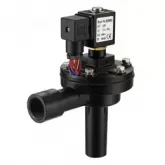
A pulse-jet dust collector uses compressed air to remove accumulated powder from filter bags or cartridges. A controller energizes a solenoid pilot, which operates the diaphragm in the dust collector valve. The valve then releases a short burst of air through a blow tube into the filter element. The pulse flexes the filter media and dislodges dust into the hopper.
The valve is one part of a system, not a stand-alone fix. Cleaning effectiveness depends on the valve’s orifice and flow capacity, pulse duration, manifold pressure, blow-tube alignment, filter condition, and the dust’s properties. If the pulse is too weak, the filter cake may remain. If cleaning is unnecessarily frequent or intense, compressed-air use rises and filter media may wear sooner.
In many installations, the dust collector valve and its air circuit are outside the product-contact zone. That does not remove the need for hygienic thinking: specify cleanable surfaces where exposed, manage leaks and condensate, and prevent maintenance debris from reaching open product. Do not assume that a valve is food-contact compliant simply because it is used in a food factory; verify the intended application, materials, and documentation with the supplier and your quality team.
Start with the collector manufacturer’s requirements, then check the site conditions. A valve that fits the pipe connection may still be unsuitable if its pulse capacity, operating pressure, temperature rating, or enclosure does not match the installation.
For a flour or sugar line, for example, the right choice may depend as much on moisture management and dust hazard controls as on the valve’s nominal size. Ask for the manufacturer’s pressure range, temperature limits, cycle-life conditions, diaphragm replacement guidance, and compatibility information. Treat advertised cycle-life figures as test-condition data, not a guaranteed service interval for a plant with different air quality or duty.
When filter differential pressure climbs or powder carryover appears, changing a valve immediately can waste time. Use a repeatable inspection sequence to identify whether the cause is the valve, air supply, controller, filter, or process.
Suppose a collector’s differential pressure rises from 800 Pa to 1,200 Pa over several production shifts, while operators report weaker cleaning pulses. Those readings are an example, not universal alarm limits. First compare them with the collector’s specified operating range. Then measure manifold pressure during a pulse, check drains and regulator behavior, and confirm that the controller is firing the intended valves. If air pressure collapses during each pulse, investigate supply restrictions before replacing diaphragms. If pressure remains stable but one row does not clean, inspect that valve, pilot, blow tube, and filter row. Record readings before and after the repair to verify the cause.
A maintenance plan should reflect pulse frequency, air quality, dust characteristics, and the manufacturer’s inspection guidance. Calendar-only maintenance can miss a rapidly developing leak, while indiscriminate replacement can add cost without addressing the real cause.
In food processing areas, coordinate maintenance with production and sanitation. Protect exposed product, control tools and loose parts, and follow the plant’s approved cleaning and line-release procedures. If washdown reaches the valve assembly, confirm that the selected enclosure and installation method are suitable; do not direct water at components that are not rated for it.
Once basic faults are controlled, system-level changes can improve reliability. Review compressed-air demand across the plant, not just at the collector. If simultaneous pulses cause a pressure dip, check the header, receiver capacity, regulator, and sequence logic with the collector manufacturer. Any adjustment should stay within the valve and filter design limits.
Use differential-pressure trends alongside inspection findings. A gradual increase may indicate filter loading or a process change; a sudden shift can point to a failed filter, blocked air supply, controller fault, or changed production conditions. Alarm thresholds should be established from the collector specification and verified operating history, not copied from another facility.
Also review combustible-dust protections as part of the complete system. Powder type, particle size, moisture, process temperature, collector location, and housekeeping all affect the risk assessment. Engage qualified safety and engineering personnel to determine applicable requirements for the facility. A pulse valve is a cleaning component, not a substitute for dust hazard analysis or engineered explosion protection.
When evaluating a replacement or new installation, prepare the collector model, valve and connection details, operating pressure, pulse sequence, ambient conditions, air-quality information, and any existing performance readings. Xingyu can be contacted to discuss dust collector valve options and application requirements. Ask the supplier to confirm compatibility with the collector design and provide technical data for the exact valve configuration before ordering.
For dust collector valves for food processing plants, a sound decision combines sanitary pulse jet valve selection with a verified pulse-jet baghouse design, stable compressed-air header, and trend-based filter differential pressure monitoring. Keep diaphragm valve specifications, Cv flow coefficient data, and air dew point requirements in the maintenance file, and use food grade dust collector valve maintenance procedures suited to the site. Contact Xingyu with your collector and operating details to review an appropriate valve solution.